
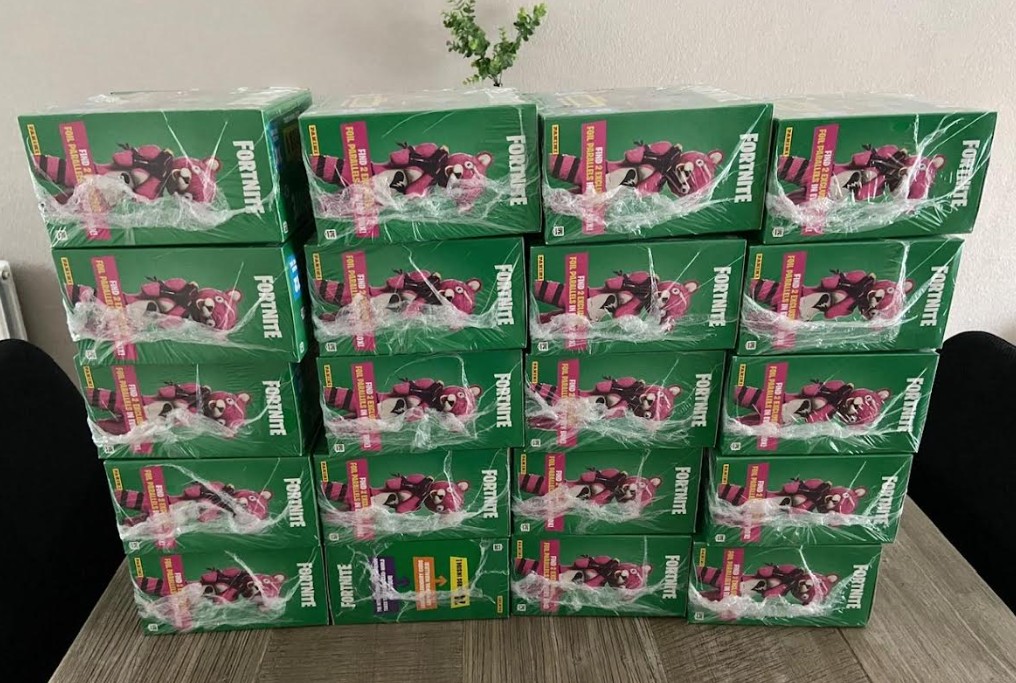
In 2019, Panini released the first series of official Fortnite trading cards. Two years later, Panini Germany was again selling Series 1 Mega Blaster Boxes through its online shop. When collectors questioned their unusual shrink-wrapping, Panini explained that the products were returns and unsold inventory that had been checked, refurbished and resealed. The company also stated that Series 1 was no longer being produced.
This investigation does not assume that Panini reprinted Fortnite Series 1. It asks a narrower question: what exactly was the physical product Panini Germany was selling in 2021?
That distinction matters because an original factory-sealed 2019 Mega Blaster Box is itself a collectible. A later-assembled or resealed box may contain entirely authentic 2019 cards without being the same collectible product.
Why the Mega Box matters
Fortnite Series 1 cards appeared as Base, Holofoil and Crystal Shard treatments. The Mega Blaster Box matters because it contained two guaranteed Crystal Shards, a parallel exclusive to that format.
This creates a direct relationship between Mega Box supply and Crystal Shard supply: every Mega Box placed two Crystal Shards into circulation. That relationship becomes important when examining Panini Germany's 2021 inventory.
February 2021: Mega Boxes return
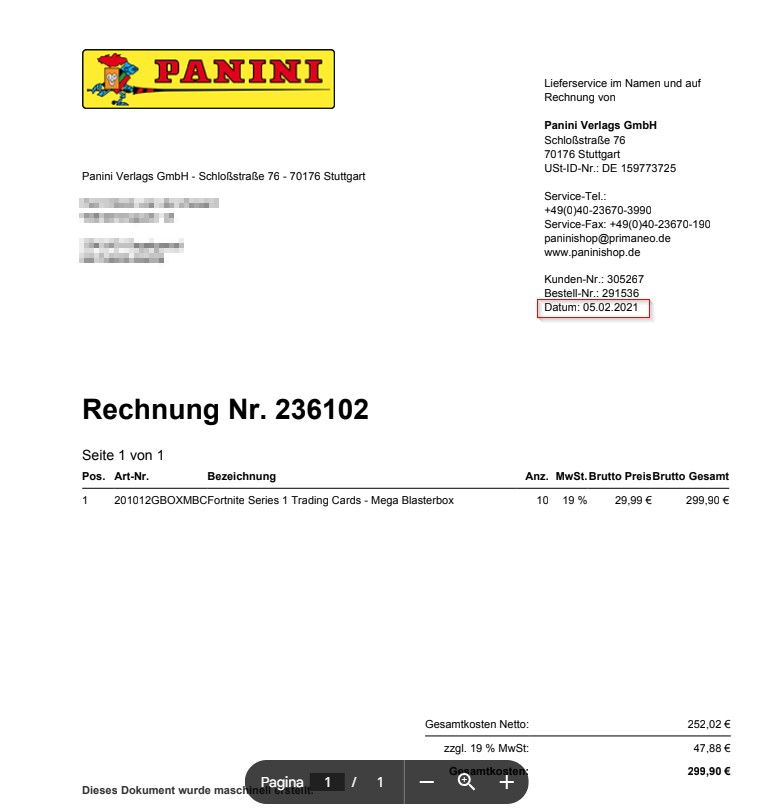
A surviving Panini Germany invoice dated 5 February 2021 documents the sale of Fortnite Series 1 Mega Blaster Boxes at €29.99 each. The invoice identifies the product as 201012GBOXMBC, the same product code used for the Mega Blaster Box on Panini Germany's online shop.
Two days later, on 7 February, Panini sent customers a newsletter announcing another opportunity to order the product. Two elements of the announcement are relevant. Noch einmal means “again” or “once again”, while Vorbestellung means “pre-order”. The wording therefore shows that Panini was making another quantity of Mega Blaster Boxes available for advance ordering rather than simply listing the product as ordinary available stock.
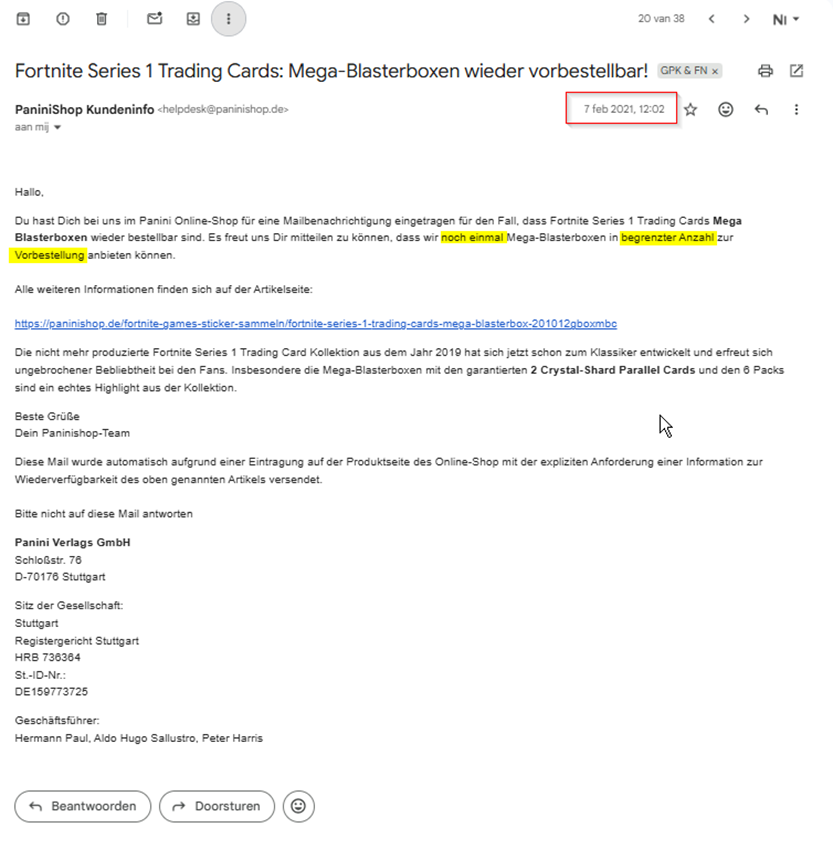
There is nothing inherently unusual about offering existing inventory for pre-order. Stock may require processing or preparation before it can be fulfilled, and the newsletter by itself provides no evidence that additional cards or boxes were being produced. Its significance lies primarily in the chronology: by early February, Panini Germany was repeatedly making quantities of a 2019 product available for pre-order. Several weeks later, when customers began questioning the condition and origin of those boxes, Panini provided a more detailed explanation of the inventory and the process used to prepare it for sale.
March 2021: Panini explains the boxes and wrapping
When customers began receiving the Mega Blaster Boxes, some noticed that the shrink-wrap did not resemble the conventional factory wrapping they expected on a sealed trading-card product. The quality of the wrapping became the subject of customer complaints, prompting Panini to explain how the boxes had been prepared for sale.
Panini acknowledged that the shrink-wrapping had been criticised and described the inventory as Rückläufer — returned goods. In a separate response, the company was more explicit, referring to the products as “returns and therefore unsold goods” and suggesting that imperfect shrink-wrap may even have contributed to some of the inventory remaining unsold in 2019.
According to Panini, the products had undergone what it called Produktaufbereitung, or product refurbishment. The company considered new shrink-wrapping necessary to ensure that the contents were complete and in good condition, and said that it used the shrink-wrapping equipment available at its logistics centre. Panini explained that it had not transported the goods elsewhere simply to obtain a better-looking seal.
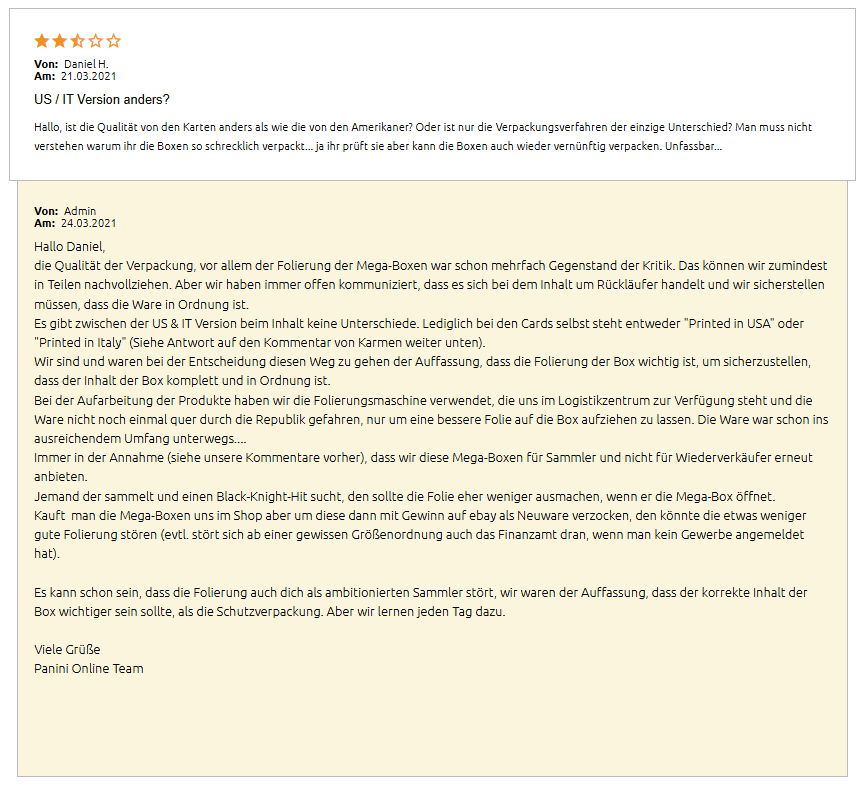
Panini's response also reveals a notable difference between the company's view of the packaging and that of sealed-product collectors. Panini argued that a collector opening a Mega Box in search of a Black Knight should not be particularly concerned by the quality of the shrink-wrap. The company acknowledged that the wrapping might matter more to someone intending to resell the unopened box and stated that it had considered the correctness of the contents more important than the protective packaging.
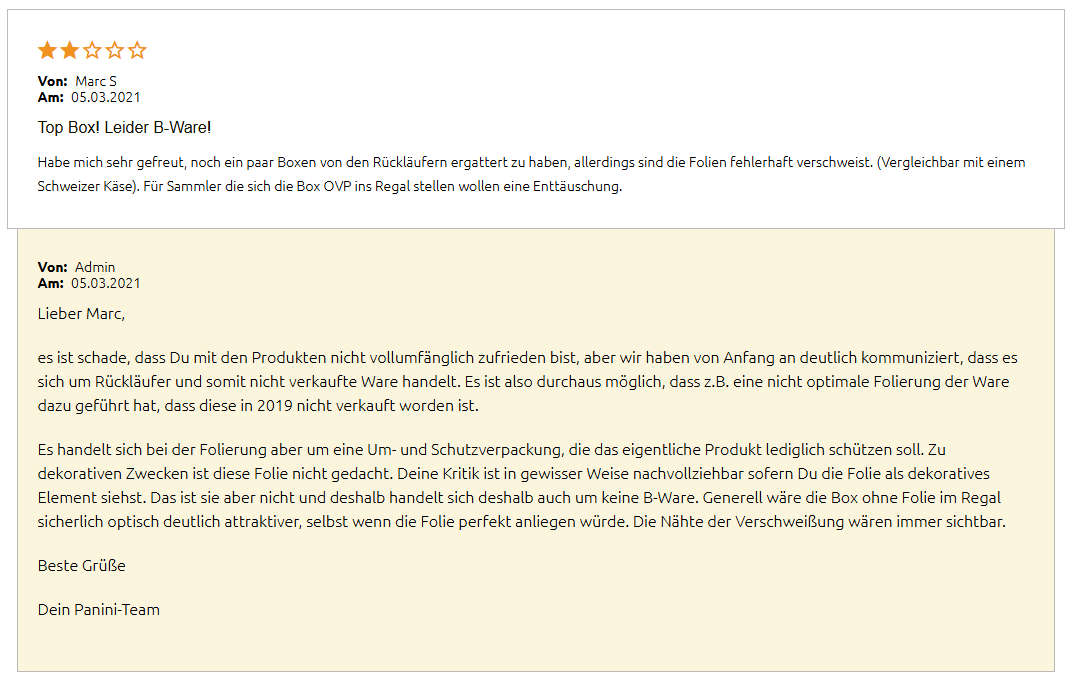
From a trading-card collector's perspective, however, those are two different questions. The authenticity of the cards inside a box does not determine whether the sealed retail product itself remains original. By 2021, Fortnite Series 1 was already being collected as sealed product as well as for its individual cards. An original factory-sealed 2019 Mega Blaster Box therefore had attributes — including its original packaging and factory seal — that could not be restored simply by applying new shrink-wrap.
If Panini's returned inventory consisted of complete factory-sealed 2019 Mega Blaster Boxes, opening those boxes for inspection and subsequently resealing them would necessarily have altered their status as original factory-sealed products. That would not make the cards in the boxes inauthentic, nor would it make Panini's refurbishment improper. It does, however, make the exact provenance and physical state of the inventory before refurbishment relevant to collectors.
Panini's responses are consistent on one important point: the company maintained that Fortnite Series 1 was no longer being produced. Its language is considerably less specific, however, about the physical form of the inventory being sold through Panini Germany.
Across its customer responses, Panini uses several related terms: Rückläufer (returns), nicht verkaufte Ware (unsold goods), Restbestände (remaining stock) and simply Ware (goods). These terms are consistent with Panini's explanation that it was dealing with inventory originating from the earlier Series 1 release, but none of them identifies precisely what that inventory consisted of. Complete retail Mega Blaster Boxes, individual Series 1 products and other forms of remaining inventory could all, in ordinary usage, fall within such descriptions.
That distinction is particularly noticeable in a public exchange dated 25–26 March 2021. A customer explicitly asked whether Series 1 and the Mega Blaster Boxes were being produced again, pointing out that Series 1 products had repeatedly become available for pre-order:
„Stimmt es das die Serie 1 und die Mega Blaster Boxen doch wieder produziert werden? […] Hier können die Serie 1 Produkte aber immer wieder neu vorbestellt werden.“
Panini replied:
„Wie wir schrieben, handelt es sich hier um Restbestände der in 2019 veröffentlichten und nicht mehr produzierten Serie.“
Or, in translation: “As we have stated, these are remaining stocks of the series released in 2019, which is no longer being produced.”
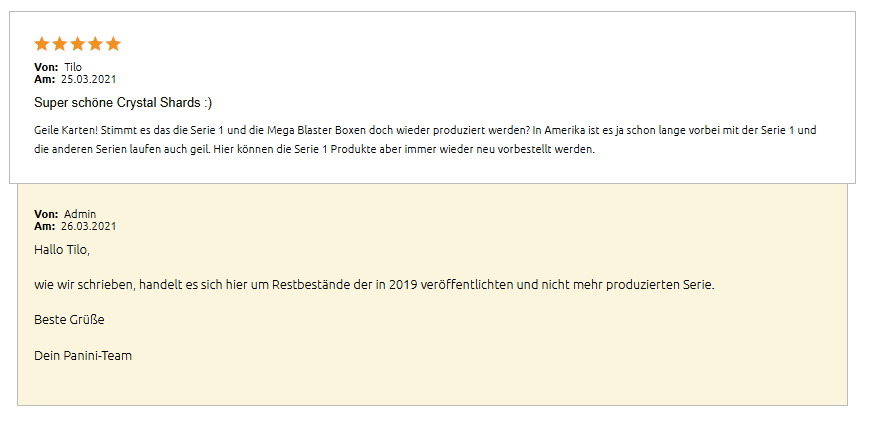
Panini's answer is important evidence against the suggestion that the company had simply put Fortnite Series 1 back into general production. At the same time, the wording does not specifically state that the Mega Blaster Boxes being sold in 2021 were complete retail boxes that had originally been manufactured, assembled and factory-sealed in 2019. The response describes the provenance of the inventory at the level of the series, rather than identifying the physical form of the Restbestände themselves.
There is no basis for concluding from this wording alone that the distinction was deliberate. Restbestände, Rückläufer and Ware are ordinary terms in customer-service and inventory language. Their lack of specificity becomes relevant only when considered alongside the other evidence, particularly the refurbishment process and the physical differences between documented Mega Blaster Boxes.
For the purposes of this investigation, therefore, “remaining Series 1 stock” should not automatically be treated as synonymous with “complete, factory-packaged 2019 Mega Blaster Boxes.” Establishing whether those two descriptions referred to the same thing requires knowing what Panini's returned and unsold inventory physically consisted of before the 2021 products were prepared for sale.
Panini's explanation of the refurbishment process contains another potentially relevant detail. While defending the quality of the replacement shrink-wrap, the company explained that it had used the equipment available at its logistics centre rather than transporting the goods elsewhere merely to obtain a better-looking seal. In the original German response of 24 March 2021, Panini wrote:
„Die Ware war schon in ausreichendem Umfang unterwegs …“
The precise meaning of unterwegs should be considered in the context in which Panini used it. The company was discussing the logistics of its refurbishment operation, rather than providing a formal account of where the inventory had originated or where it was being transported. Nevertheless, the wording indicates that sufficient quantities of the Ware — the goods — were already moving through that process.
Placed alongside the February sales, this adds another piece to the chronology. A surviving invoice documents Mega Blaster Boxes being sold on 5 February 2021. Two days later, Panini announced that it could “once again” offer a limited number for pre-order. By 24 March, while responding to questions about the unusual wrapping, Panini was describing sufficient quantities of the goods as already unterwegs and explaining why the available logistics equipment had been used to refurbish them.
None of these statements indicates new production. They do, however, leave the same question about the physical inventory unresolved.
Resealing explains the plastic. But what about the box?
A comparison between a Mega Blaster Box supplied through Paninishop.de during the later German sales and an earlier retail Mega Box purchased directly from Panini Italy in December 2020 reveals differences that cannot be explained by replacement shrink-wrap alone.
The earlier retail box carries printed pricing information for the markets in which the product was distributed. The later Paninishop.de box does not. The two documented boxes also carry different barcode information. These are features of the printed cardboard packaging itself, rather than the plastic wrapping applied around it.
Additional documented Series 1 retail packaging provides useful context. Boxes from the earlier European distribution carry printed regional pricing, while the Mega Blaster Boxes and regular Blaster Boxes documented from the later Paninishop.de sales lack that pricing.
This does not establish when the later cardboard packaging was manufactured. Different packaging could have existed during the original production period for different markets, distribution channels or other commercial reasons. Nor does different packaging establish that any cards inside were newly printed.
It does, however, create a problem for the simplest interpretation of the refurbishment explanation. If the 2021 products were complete original retail Mega Blaster Boxes that had merely been opened, inspected and resealed, replacement shrink-wrap would explain the new plastic seal. It would not, by itself, explain why the printed cardboard box underneath was different.
If Panini received complete original 2019 Mega Blaster Boxes, the process could have been relatively straightforward: the original boxes were opened, their contents checked, and those same boxes resealed. Such a process would closely fit Panini's explanation and would account for the unconventional shrink-wrap. The differences in the cardboard packaging leave open another possibility, however. Genuine 2019 cards and packs could, in principle, have been repackaged or assembled into a retail product at a later stage without requiring any additional production of the cards themselves.
Crystal Shards appear in quantity
The German secondary market provides another piece of circumstantial context. Following the renewed availability of Series 1 Mega Blaster Boxes through Panini Germany, sizeable groups of Italy-print Crystal Shards appeared for sale through German collectors and sellers.
One German auction offered 91 different Series 1 Crystal Shards in a single lot. Another offered 50 different Italy-print Crystal Shards, attracting 19 bids before selling for €510, or an average of €10.20 per card. A separate private transaction documents another substantial group of Crystal Shards, this time including duplicate cards.
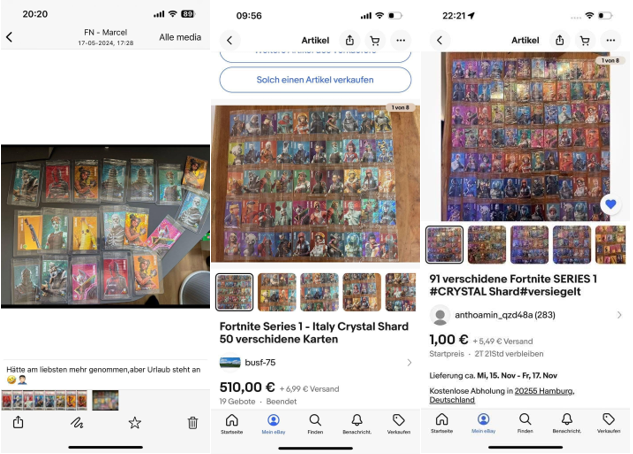
The quantities are notable because Crystal Shards were exclusive to the Mega Blaster Box, with two guaranteed in each box. Fifty Crystal Shards are therefore equivalent to the guaranteed Crystal Shard output of 25 Mega Boxes, while 91 cards represent the equivalent output of 45.5 Mega Boxes.
These examples do not establish where the cards originated beyond their Italy print designation, nor do they establish when they were manufactured. There are ordinary secondary-market explanations for such concentrations. A collector could have opened large numbers of Mega Boxes, a dealer could have accumulated cards from multiple sources, or individual sellers could have retained more valuable cards while disposing of the remainder in bulk.
What the examples do establish is considerably narrower: substantial concentrations of Italy-print Crystal Shards were present in German hands following the period in which Panini Germany had again been supplying Series 1 Mega Blaster Boxes.
The condition question
Italy-print Fortnite Series 1 cards developed a reputation among collectors for condition problems during the original release period. Crystal Shards were frequently part of those discussions, with collectors reporting white edge chipping, crimping and a recurring pinched or compressed corner that became informally known as the “Italy corner.”
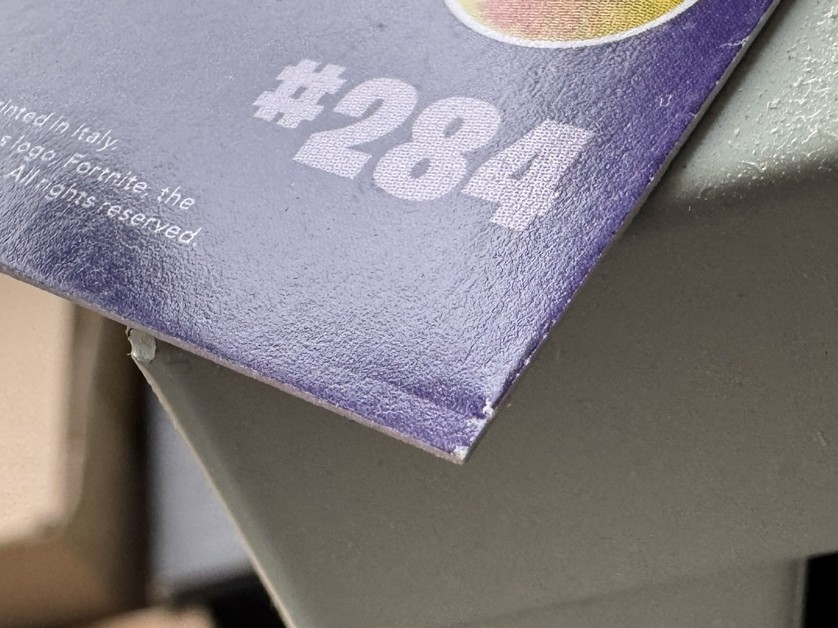
On pronounced examples, the corner defect is considerably more substantial than a small nick at the tip of the card. The deformation can extend along the edge for more than a centimetre, leaving a visibly compressed or pinched section of the card.
This distinction is important because collectors have also used the term “Italy corner” for much smaller imperfections appearing in approximately the same location. For this investigation, those defects should not automatically be treated as equivalent. A small localized nick and an extended compression differ substantially in scale and morphology, making the severity and physical characteristics of the defect more useful for comparison than the informal label itself.
A second recurring condition issue is edge chipping. On the dark-backed Crystal Shards, damage to the printed surface exposes the white card stock beneath and can be particularly conspicuous.
Similar condition problems were being discussed by collectors while Fortnite Series 1 was still a contemporary product. On Blowout Forums and other collector communities during 2019 and 2020, Italy-print cards — and Crystal Shards in particular — acquired a reputation for recurring corner, crimping and edge problems. Those reports continued during the German Mega Box sales in 2021. In March of that year, a collector describing a freshly pulled Italian card referred to its rear corner as being “pinched like you see so often with the Italian cards.” One collector predicted a “glut of raw Italian stuff” as German Mega Boxes were opened and described many of the cards as having the recurring bad corner.
That observation cannot establish that the cards themselves changed. Collector activity changed over time, fewer sealed boxes may have been opened and discussed publicly, and a familiar defect may simply have stopped being noteworthy enough to mention. Forum activity is therefore evidence of contemporary collector experience, not a production record. It does, however, provide a useful benchmark against which later Italy-print Crystal Shards can be examined.
The Black Knight population anomaly
PSA's population report provides the most quantifiable anomaly in the available data. It also requires careful interpretation. A PSA population is not a production population: collectors have a much greater financial incentive to grade a valuable Crystal Shard than an ordinary Base card, and submission behaviour can vary substantially between cards, markets and periods. PSA populations therefore cannot be converted directly into estimates of how many cards were originally produced.
Black Knight #252 nevertheless provides a particularly useful comparison because the same highly desirable character can be examined across Base, Holofoil and Crystal Shard treatments, and across different print versions.
USA Black Knight #252
| Treatment | PSA population | PSA 10 | Gem rate |
|---|---|---|---|
| Base | 662 | 111 | 16.8% |
| Holofoil | 210 | 20 | 9.5% |
| Crystal Shard | 44 | 9 | 20.5% |
The USA population broadly follows the underlying product hierarchy: Base is by far the most common treatment in the PSA population, followed by Holofoil, with Crystal Shard substantially lower. The Italy population looks very different.
Italy Black Knight #252
| Treatment | PSA population | PSA 10 | Gem rate |
|---|---|---|---|
| Base | 210 | 44 | 21.0% |
| Holofoil | 88 | 3 | 3.4% |
| Crystal Shard | 167 | 39 | 23.4% |
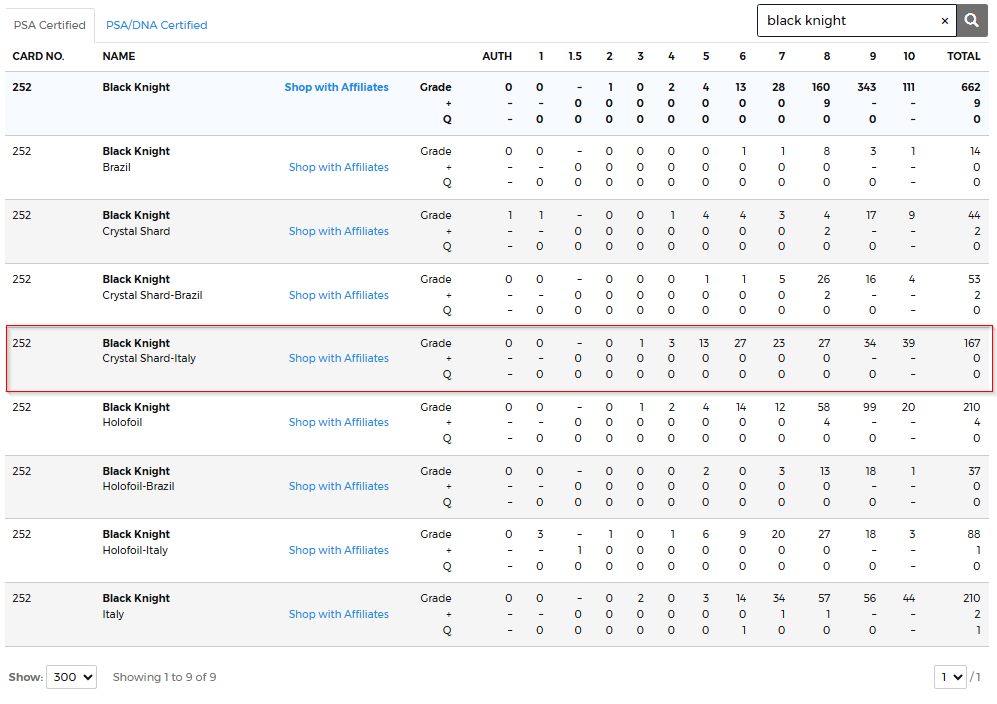
Here the pattern no longer resembles the USA population. PSA has graded almost twice as many Italy Crystal Shards as Italy Holofoils, while the Crystal Shard population is also remarkably close to the Base population: 167 versus 210.
The difference becomes particularly clear when Crystal Shards are compared with Base cards. For the USA print, the 44 graded Crystal Shards represent 6.6% of the 662-card Base population. For Italy, the 167 Crystal Shards represent 79.5% of the 210-card Base population. The Crystal-to-Base ratio in the Italy PSA population is therefore approximately twelve times the equivalent USA ratio.
That comparison should not be interpreted as evidence that Panini produced twelve times as many Italy Crystal Shards relative to Base cards. PSA data reflect collector submission decisions as well as the underlying card supply, and valuable parallels are disproportionately likely to be graded. The USA population is useful precisely because the same incentive exists there, yet the PSA populations still decline substantially from Base to Holofoil to Crystal Shard.
What the evidence does — and does not — establish
There is currently no production order, manufacturing record or internal Panini communication demonstrating that additional Fortnite Series 1 Crystal Shards were produced for the German market in 2021. The available evidence therefore does not justify stating that Panini reprinted Fortnite Series 1.
The binary question of “reprint or no reprint,” however, may be too broad for what happened in Germany. Based on the available evidence, three materially different scenarios remain possible.
Scenario 1 — Original 2019 retail Mega Boxes
Panini recovered complete original Mega Blaster Boxes as returns and unsold stock, opened them to verify their contents and resealed those same boxes. This is the interpretation closest to Panini's public explanation. Under this scenario, all of the contents and the retail packaging would originate from the original production period, and the differences observed in the printed cardboard packaging would still require an explanation.
Scenario 2 — Original 2019 components, later assembled into Mega Boxes
Panini recovered genuine Series 1 inventory from the original production period, but that inventory did not necessarily consist entirely of complete Mega Blaster Boxes. Existing packs, cards and Crystal Shards could subsequently have been assembled or repackaged into Mega Boxes for the 2021 sales, potentially using different cardboard packaging. Under this scenario, no cards need to have been reprinted — but the 2021 product would not simply be a complete original 2019 Mega Blaster Box that had been opened, checked and resealed. For sealed-product collectors, that distinction would be significant.
Scenario 3 — Original inventory supplemented with additional Crystal Shards
The third scenario is the specific hypothesis that has circulated among collectors. Under this theory, Panini genuinely recovered Restbestände, Rückläufer and nicht verkaufte Ware from the original Series 1 release, as the company stated, but supplemented that inventory with newly produced Italy-print Crystal Shards and new Mega Box packaging in order to create additional Mega Blaster Boxes.
This is considerably narrower than alleging that Panini simply reprinted Fortnite Series 1. If substantial quantities of original cards and packs were available, there would be little reason to reproduce them. If Panini was assembling additional Mega Boxes from other remaining Series 1 inventory, the potential bottleneck would have been the defining component of that format. That distinction also separates the Mega Blaster Box from the regular Blaster Boxes Panini Germany was selling: their guaranteed Holofoil hits also appeared through other Series 1 products, while creating additional Mega Boxes would require two examples of a Mega-exclusive parallel for every box assembled.
There is currently no direct evidence establishing that Panini produced those additional Crystal Shards. The hypothesis remains unproven.
The unresolved question
Taken individually, each of these observations has plausible explanations that do not involve additional production. Even considered together, they do not prove that additional Crystal Shards were manufactured. What they leave unresolved is exactly what Panini Germany's Restbestände consisted of and how those goods became the Mega Blaster Boxes delivered to customers in 2021.
The central question is therefore not whether Fortnite Series 1 was broadly “reprinted,” but whether all of the components used to create the Mega Blaster Boxes sold through Panini Germany in 2021 already existed as part of the original production inventory.
Production and inventory records could resolve the issue. In particular, three questions would substantially clarify the provenance of the German Mega Boxes:
- What physical form did the Rückläufer, Restbestände and nicht verkaufte Ware take before Panini's refurbishment process — complete Mega Blaster Boxes, opened boxes, packs, cards or some other form of Series 1 inventory?
- Were the Mega Blaster Boxes delivered to customers in 2021 the same physical cardboard retail boxes in which their contents had originally been packaged, and if not, when was the later packaging produced and the finished product assembled?
- Were any Italy-print Series 1 Crystal Shards printed, collated or packaged after the original production period?
Clear answers could make the entire mystery mundane. They might establish that everything sold through Panini Germany consisted of original inventory whose unusual packaging, distribution and population characteristics have straightforward logistical explanations.
Until that provenance is established, however, describing the 2021 Mega Blaster Boxes simply as “old stock that Panini resealed” answers only part of the question. For collectors, that distinction matters independently of whether a single additional Crystal Shard was ever printed.
An original 2019 card and an original factory-sealed 2019 retail box are not the same collectible.
Explore more
2019 Panini Fortnite Series 1 Checklist — Browse the complete Series 1 checklist, including Holofoil and Crystal Shard parallels.
Black Knight #252 Crystal Shard — View the individual card reference discussed in the population analysis above.
Crystal Shard Collector Gallery — Real-world collector photography of Panini Fortnite Crystal Shard cards.
Source & Editorial Note
This article is based on documented material supplied by collectors: a Panini Germany invoice dated 5 February 2021, Panini's published customer-service responses from March 2021, photographs of Mega Blaster Box packaging, German secondary-market listings and PSA population data as displayed at the time of writing. PSA populations change as additional copies are graded. Nothing in this article asserts that Panini reprinted Fortnite Series 1. Fortnite Cards Vault is an independent collector-built reference and is not affiliated with Panini, Epic Games, PSA or eBay.